
There is a particular kind of humiliation that only five-a-side football can deliver. You see the gap open up, you know exactly what you want to do, and then someone smaller, older, or apparently less athletic than you simply gets there first. No dramatic collision, no contested duel – just the quiet indignity of being half a step too slow. In a full eleven-a-side match, that half step is sometimes forgivable. On a five-a-side pitch, where the entire playing area might be smaller than a tennis court, it is the difference between relevance and irrelevance.
Speed in five-a-side is not quite the same thing as speed in the full game, and that distinction matters more than most recreational players realize. Understanding what kind of speed you actually need – and then training for it specifically – is where the real gains are hiding.
It is also why shortcuts and false promises rarely translate onto the pitch. The idea of instant success – the kind of appeal you might associate with something like a Wanted Win Casino no deposit bonus — has very little place here. In five-a-side, improvement is stubbornly physical and deeply specific: quicker first steps, sharper changes of direction, and better anticipation. There is no substitute for repetition, awareness, and the willingness to be just a fraction faster the next time that gap opens up.
Why Five-a-Side Is a Different Beast
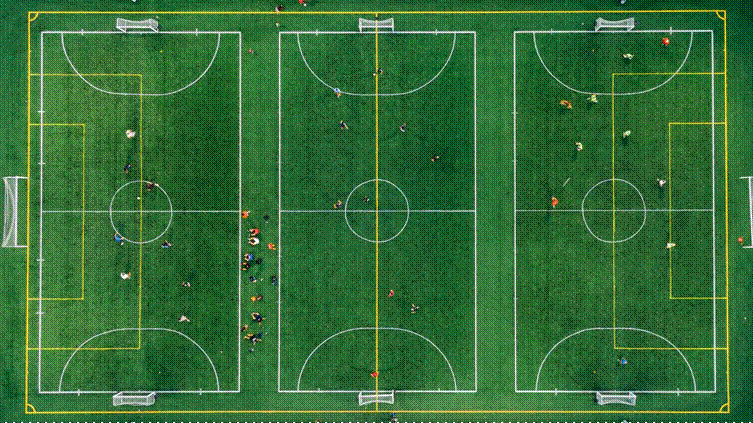
The conventional image of football speed is the long, lung-burning sprint: a winger in full flight down the touchline, legs pumping, covering forty or fifty metres before anyone can catch them. That version of speed is almost entirely irrelevant to five-a-side. On a small pitch packed with bodies, you are rarely going to sprint more than five or six metres before you run into a wall, a defender, or the boundary. The distances are compressed; the decisions are faster; the consequences of half a second’s hesitation are immediate and obvious.
What five-a-side actually demands is acceleration – the ability to go from standing or jogging to full pace in the space of two or three strides – combined with the ability to stop sharply, change direction, and accelerate again. It also demands that you do all of this while keeping your head up and processing what is happening around you, because the player who is only fast in a straight line is far less dangerous than the player who is fast and aware.
This is why simply going for long runs or hammering out sprint drills on a full-size pitch will not necessarily translate into better five-a-side performance. The physical demands are specific, and the training needs to match them.
Train the Whole Body, Not Just the Legs
One of the most common mistakes players make when trying to get faster is focusing exclusively on their legs. Squats, leg presses, hamstring curls – all useful, but not the complete picture. Fitness coaches consistently emphasize that genuine athletic speed comes from full-body strength and coordination, not isolated muscle development.
The reasoning is straightforward. When you change direction sharply at pace, your entire body is involved in managing that movement – your core stabilizes you, your upper body helps you pivot, your arms drive your acceleration. A player who has strong legs but a weak or uncoordinated upper body will leak energy with every movement. By contrast, a player who trains as a complete athlete – working the whole body in integrated, functional patterns rather than isolating individual muscles – develops the kind of balanced power that translates directly to what happens on the pitch.
This does not mean you need to abandon leg work. It means that leg work alone is insufficient. Compound movements, rotational exercises, and work that demands coordination across multiple muscle groups simultaneously will make you a more explosive, more agile player in ways that the leg press machine simply cannot.
Forget Distance, Focus on Explosiveness
Given that the maximum useful sprint in five-a-side is rarely more than six metres, the way you train your sprinting needs to reflect that reality. The starting position matters enormously here. Coaches recommend leaning slightly forward from the torso, keeping the back straight, and driving the knees upward at the start of each burst. These short, explosive strides generate the initial acceleration that makes the difference in a tight space.
Equally important – and often neglected – is the ability to stop. The faster you can accelerate, the more critical your braking becomes. Slowing down sharply in five-a-side requires shifting your weight back onto your heels, dropping your hips, and controlling your deceleration without losing balance. Players who can stop quickly and cleanly can immediately redirect their energy into the next movement. Players who cannot tend to overshoot, stumble, or simply lose the split-second timing that small-sided football runs on.
The 5-10-5 Drill and Why It Works
One specific training exercise that fitness coaches recommend for five-a-side players is the 5-10-5 drill, borrowed from American football, where it is used to evaluate the lateral quickness and change-of-direction ability of players at the highest level. The setup is simple: three cones placed five metres apart. You start at the central cone, sprint to one of the outer cones, then run the full ten metres to the other outer cone, then return five metres back to the centre. The total distance is modest. The intensity is not.
What makes this drill valuable is that it replicates exactly the kind of movement pattern that five-a-side demands: short, sharp bursts with direction changes in between. It trains both your legs and your nervous system to switch quickly between acceleration and deceleration, which is precisely the physical vocabulary of the small-sided game.
You can increase the difficulty in a couple of ways. Having a training partner call out the direction you should move – rather than deciding in advance – adds a reaction component that mirrors the unpredictability of a real match. You can also perform the drill with a ball, which adds the coordination challenge of controlling the ball while moving at pace. This combination of physical and cognitive demand is exactly what five-a-side puts in front of you every few seconds during a game.
Keep Your Head Up – Seriously
This is advice that coaches have been giving players for as long as football has existed, and it remains relevant because it remains difficult. In five-a-side particularly, the temptation to look down at the ball – especially when moving quickly, when the pressure is on, when the pitch feels crowded – is constant and understandable. And it is also a serious tactical liability.
Players who keep their heads down lose awareness of the space around them, miss teammates making runs, and become predictable to opponents who can read their body language without any risk of being surprised. In a game where everything happens faster and in a tighter space, that loss of awareness is amplified. The 5-10-5 drill, used with a partner pointing the direction rather than calling it out, is an excellent tool for developing the habit of keeping your eyes up even while moving at speed. Training the body to react to visual cues rather than verbal ones more closely replicates actual match conditions.
Leg Power and the Box Jump
For the sustained, repeated bursts of acceleration that five-a-side demands, upper leg strength is foundational. The quadriceps, hamstrings, and glutes are the engines of your sprinting, and keeping them powerful enough to function consistently across an entire match – rather than just the first ten minutes – requires specific work.
Box jumps are among the most effective exercises for developing this explosive leg power. The movement trains the muscles to produce rapid, forceful contractions – the exact same demand that a sharp sprint makes. The height of the box matters less than the quality of the movement: each jump should be executed with full effort and proper landing mechanics, and the set should stop well before fatigue starts to compromise form. The goal is power development, not endurance, so keeping sets short and resting properly between them produces better results than grinding through high-repetition sets on tired legs.
Stamina: The Underrated Speed Factor
Here is the uncomfortable truth about speed in five-a-side: in the final stages of a match, the fastest players are often not the ones who were fastest at kick-off, but the ones who are least tired. Fatigue is the great equalizer. It slows your legs, clouds your decision-making, and strips away the sharp reactions that good five-a-side play depends on. A player with average top-end pace but excellent cardiovascular conditioning will consistently outperform a faster but less fit opponent over the course of a full game.
This means that speed training cannot be separated from endurance training. Running longer distances at moderate intensity – not sprinting, just sustained aerobic work – builds the cardiovascular base that allows your fast-twitch muscles to keep firing when everyone else is flagging. The sprint that wins the match in the last two minutes is only available to the player who did the boring, unglamorous aerobic work in training.
Get Your Footwear Right
Finally, and more practically than anything else: wear the right boots for the surface you are playing on. This sounds trivially obvious, but the number of players who show up to artificial pitches in shoes designed for natural grass is remarkable. Inappropriate footwear on artificial surfaces is uncomfortable, potentially damaging to the shoe, and – crucially – slower. The grip is wrong, the energy transfer through each stride is inefficient, and the wear on the sole degrades performance over time.
Most major manufacturers now produce shoes with AG soles specifically designed for artificial surfaces. These tend to be lighter, with stud patterns optimized for the consistent hardness of artificial turf. When you are trying to shave fractions of a second off your reaction time and acceleration, the last thing you want is equipment working against you.
Five-a-side is a game that rewards intelligence, technique, and awareness. But underneath all of that, it rewards the player who can simply get to the ball first. That player is not born – they are built, one purposeful training session at a time.