
In British India, back in 1888, the Durand Cup was founded in Annadale, Shimla City, India. It was one of the first soccer competitions in the world, appearing just 26 years after the founding of the oldest professional club, Notts County (or 31 years after the 1857 founding of Sheffield FC, the oldest club in any category).
Despite this heritage, no team in the region of South Asia has ever qualified for a World Cup – with one minor exception.
Lack of Interest
First, let’s address that exception. Technically, one team in a region occupied by India, Bangladesh, Pakistan, Nepal, Sri Lanka, Bhutan, and the Maldives has qualified for the World Cup. India achieved the feat in 1950. It came just two years after a surprisingly close loss (1-2) to France at the London Olympics in 1948. Reportedly, the Indian side played barefoot.
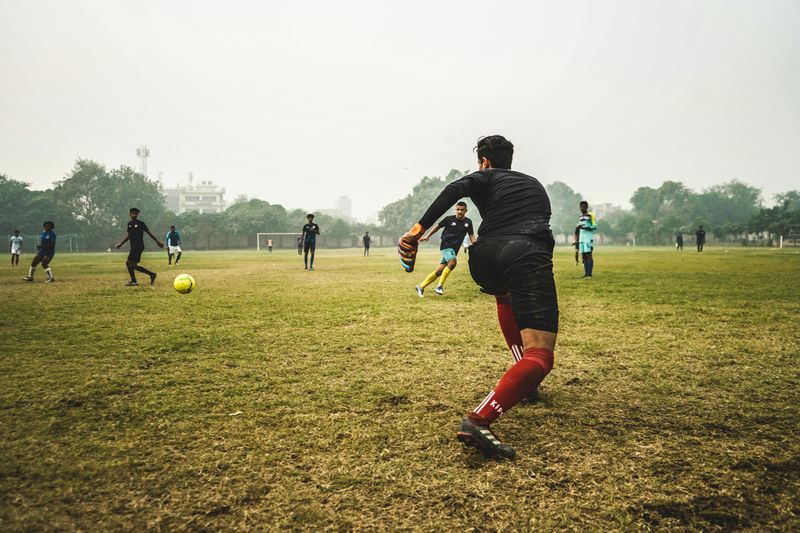
India would actually withdraw from the World Cup before arrival, with the story generating several urban legends. Their departure has been chalked up to a lack of funds to travel to the competition site in Brazil, and a general lack of interest from the All India Football Federation. India’s withdrawal completed a quartet of Asian sides that had already withdrawn.
The absence of India from the 1950 World Cup has been mourned ever since. Then-captain Sailen Manna, who died aged 87 in 2012, once told Sports Illustrated that Indian soccer would be “on a different level” if they’d been able to compete.
An LA Times article from 2011 completed the story, adding that India made a second appearance in soccer at the 1952 Olympics in Helsinki (again, in bare feet), losing 1-10 to the almighty Yugoslavia.
Media Positioning
In Europe, many teams are household names, the likes of Bayern Munich, Real Madrid, and Arsenal. This is largely a product of clever marketing, TV appearances, and merch sales. An adjacent industry, sports betting, thrives in many Western markets, giving fans another way to interact with their favorite team off the field.
The latter eventually became an online phenomenon, further integrating soccer into popular culture. The appearance of casino games based on the sport was a continuation of much the same thing. While most commonly associated with slot games like the Rainbow Riches slots, operators have folded soccer into games like roulette and scratchcards, with games like World Cup Football Scratch ‘n’ Go an example.
This kind of approach has never quite worked in India – it might’ve, once, if cricket hadn’t received the lion’s share of money and media positioning. The Economic Times of India summed up the country’s “inability” to play soccer by comparing it to why ravioli isn’t popular on the Subcontinent – a “top food choice like momo” is too well-established.
Viewing Figures
It’s an unfortunate position to be in, especially given South Asia’s historical absence from the World Cup, and the position of something like the Durand Cup in soccer’s chronology. Also, due to India’s population size, it’s 1% of soccer fans contributes a vast number (14m) of global viewing figures.

The problem is, India simply doesn’t have much of an interest in being a soccer-going nation, something already associated with the All India Football Federation since 1950.
As for the World Cup in 2026, the story has already repeated itself. No South Asian teams have qualified. The nearest successful nations are Uzbekistan in the west and South Korea/Japan in the east. Maybe the 2028 Olympic Games will produce a much overdue near-success for India.